
Three is Greater Than Two
By Albert Zhu| January 7, 2019

The NBA game is constantly evolving. From the towering giants of the ‘80s and ‘90swho patrolled the paint and relied on post play to the dominant wing players of the early 2000swho thrived on isolations, offenses and defenses have changed with the times, with different timeperiods featuring different playstyles. And one only has to watch two minutes of today’s game tofigure out the defining aspect of the modern NBA: the three-point shot.
Ever since Stephen Curry and the Golden State Warriors burst onto the national stage,winning three championships in four years while featuring an offense that perfectly utilized twoof the greatest three-point shooters in NBA history, teams all over the league have been trying toemulate the Warriors’ historically efficient offense. Almost every NBA offense today has four tofive capable three-point shooters on the court at all times, and teams are launching more threeswith each passing year. That was on display Saturday night as the Warriors and Kings broke anNBA record, combining for 41 three-pointers and the first ever game where both teams made 20.
The principle behind taking more three-pointers is simple: if a team can shoot close to thesame percentage on three-pointers than it can on two-pointers, consistently, then three is greaterthan two and more points scored leads to more games won. With this in mind, does taking morethree-pointers actually amount to a higher chance of winning games? From 2015-2018, the pastthree NBA seasons have shown a clear trend:
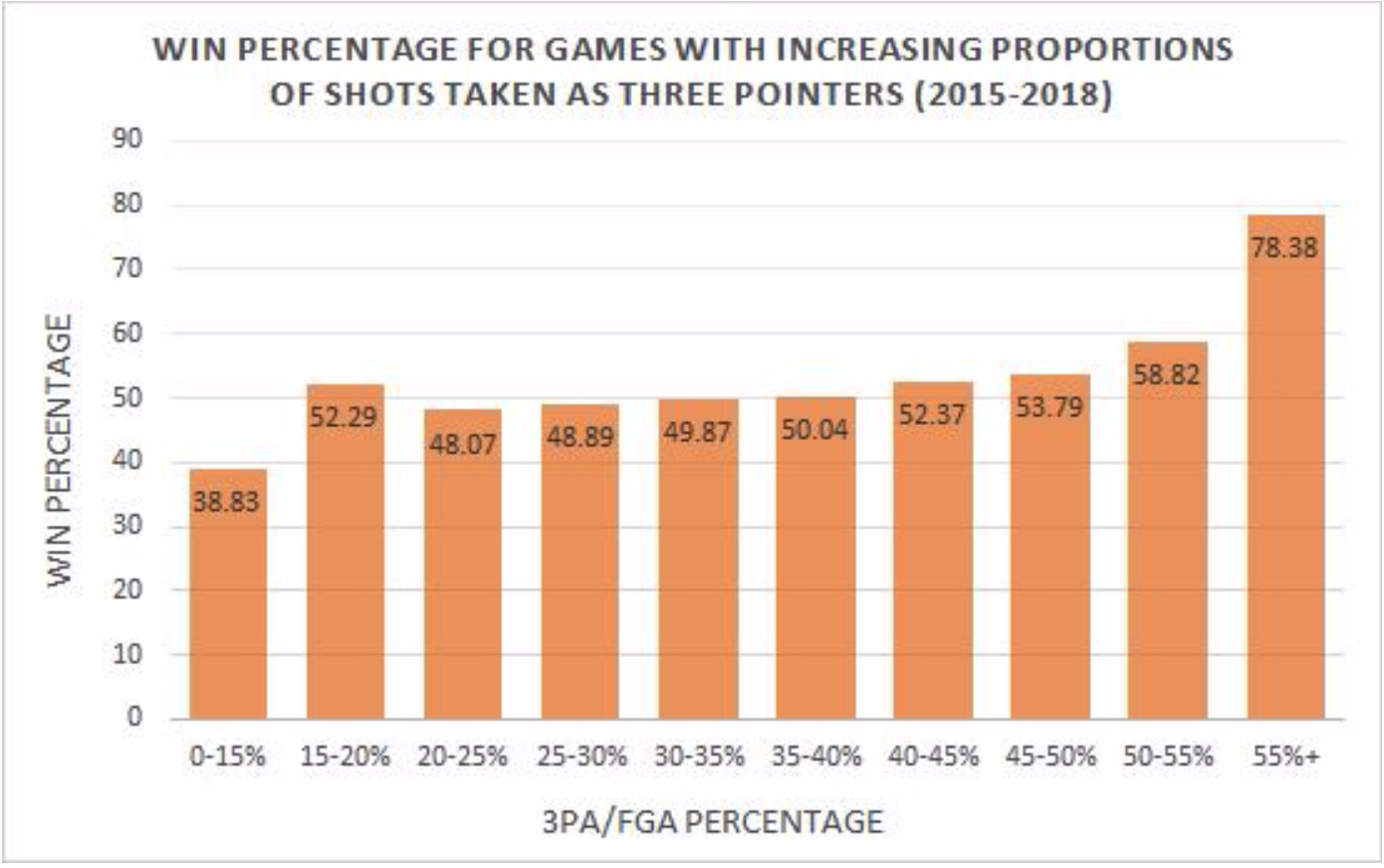
From every single NBA game that was played from the ‘15-16 season to the ‘17-18season, as the percentage of total shots taken as three-pointers (3PA/FGA%) increases, thechance of that team winning the game also increases, with win percentage rising as high as78.38% for games in which a team shoots over 55% of their shots as three-pointers. In addition,games in which a team attempted at least 40 three-pointers resulted in wins for that team 57.49%of the time, while games with at least 50 three-pointers attempted had an even higher 76.0% winpercentage. While these numbers provide a clear justification for NBA teams taking more andmore threes each year, it doesn’t necessarily mean that bottom-feeder teams who simply jack upmore three-pointers will suddenly become championship contenders. Just like how the Warriors’uber-talented team, featuring four to five all-stars, allows each player to get easier looks fromthree, the talent and personnel on each team makes a huge difference in how many openthree-pointers are attempted and how many games are won. In determining how manythree-pointers should be taken per game to maximize win percentage, quality of three-pointattempts must be taken into account along with quantity. Plotting the W/L% (win/losspercentage) of all 30 NBA teams from the same time period (2015-2018) and comparing it to theaverage 3PA/FGA% over those three seasons, there is a slight correlation between team successand percentage of shots taken as three-pointers.
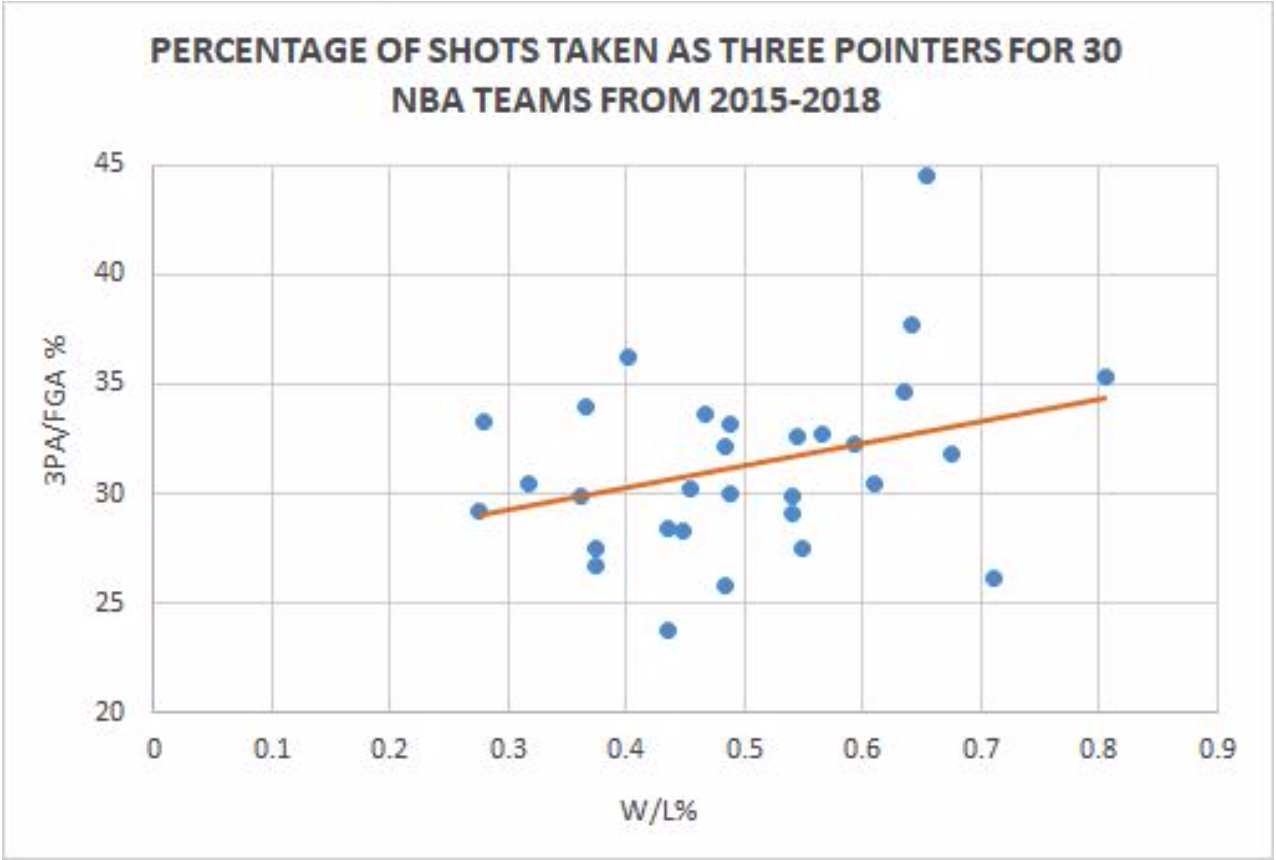
Based on the data, teams that are more successful with more talented players tend to takemore of their shots as three-pointers. This is often due to the personnel on these successful teams,with teams such as the Warriors, Rockets, and Celtics featuring countless three-point shooters onthe starting lineup and on the bench. This shows that although teams who simply decide to shootthree-pointers as often as possible may not be more successful, teams that seek out provenshooters while implementing offensive strategies to maximize their three-point effectiveness willbe more successful.
Due to a small sample size of games where teams attempted over 60% of their shots asthree-pointers (six total games, all wins) there is currently not enough data to determine whetheror not there exists a point of diminishing returns for taking more three-pointers. As teamscontinue to break three-point records each year, the question of how many threes is too manywill soon be answered. If it turns out that this point of diminishing returns doesn’t exist, then itmay not be absurd to expect the introduction of the NBA four-point line in the near future...